

From Pipes to Probabilities: Using Public Data and AI to See Wastewater Upgrades Before They Go to Bid
In wastewater infrastructure, advantage seldom belongs to the firm that moves fastest after a tender appears. More often, it belongs to the one that understood the underlying need before the market gave it a project number. Utilities do not decide overnight to modernise a treatment train, rehabilitate a collection network, or rethink biosolids handling. Long before procurement becomes visible, a quieter sequence is already in motion — and that sequence leaves evidence in public.
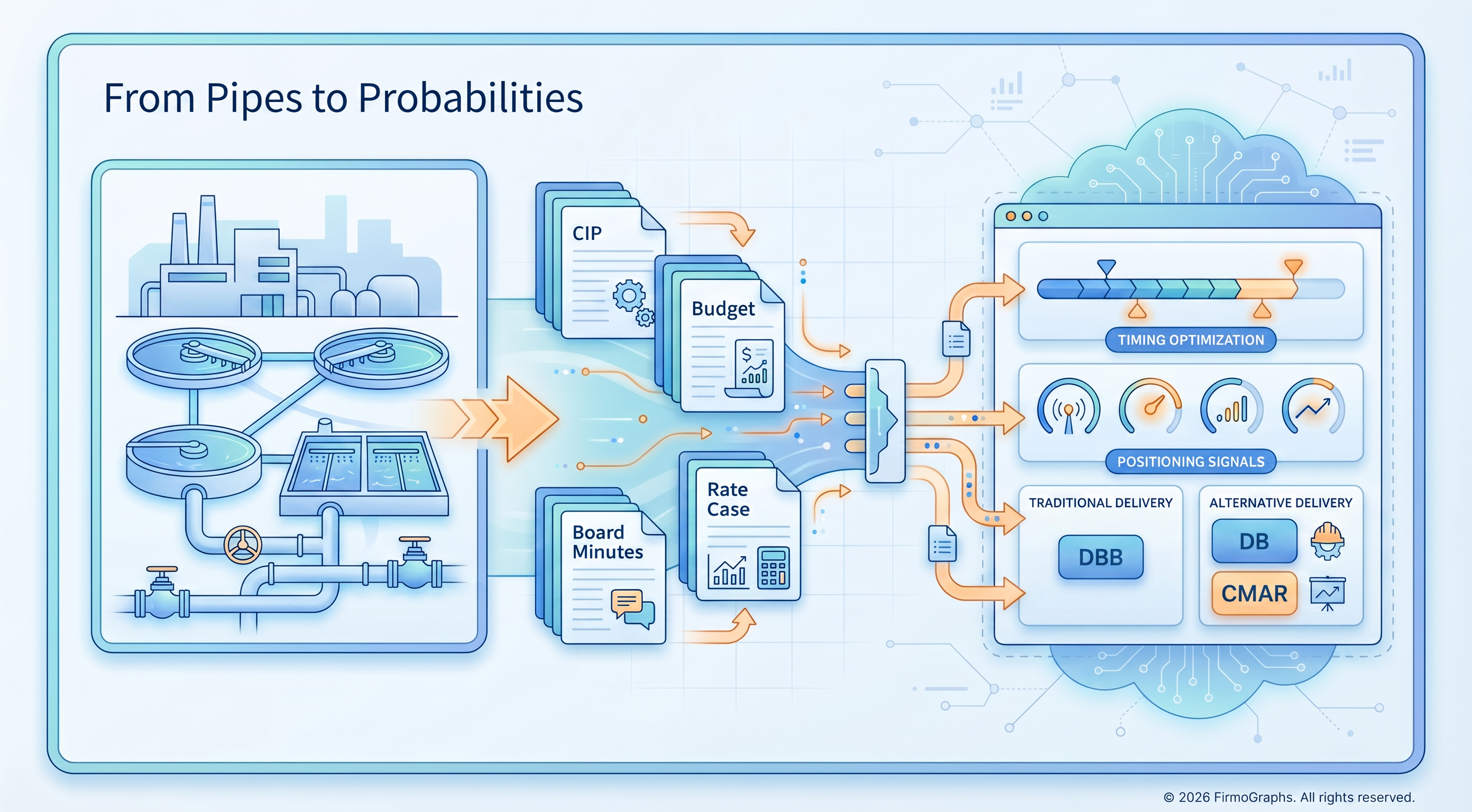
A capital improvement plan may flag a recurring capacity issue. A budget document may show that funding assumptions are hardening. Board materials may reveal that staff are weighing engineering options, regulatory exposure, or deferred maintenance backlogs. Looked at together, these records begin to suggest where future wastewater investment is forming. Yet the market still often behaves as though opportunity begins only when it is formally announced. By then, scope has crystallised, internal priorities have been tested, and firms that arrive at bid day compete on price and speed rather than insight and fit.
A Different Way of Reading the Market
A more serious approach starts from a simpler premise: utilities generate signals before they generate solicitations. Capital plans, budget books, rate discussions, compliance documents, resilience studies, enforcement actions and public meeting records all carry fragments of institutional intent. None is complete in isolation. Together, they reveal how utilities think about risk, timing and capital necessity — often years ahead of formal procurement.
This matters because wastewater is not merely a technical market. It is shaped by regulation, public finance, long asset lives and political accountability. A treatment plant upgrade may be driven as much by permit pressure and operational fragility as by engineering ambition. A lift-station rehabilitation programme may reflect years of deferred maintenance and recurrent system stress. Understanding those conditions often matters more than reacting to the eventual solicitation notice.
Read in that way, the public record becomes less like background documentation and more like an early-warning system — helping distinguish between projects that are merely listed and those that are acquiring institutional momentum.
Why Delivery Method Changes Everything
Knowing early only creates real advantage when the delivery method leaves room to act on that knowledge. This is the distinction that separates useful intelligence from interesting trivia — and it is where alternative delivery becomes central to the conversation.
In a traditional Design-Bid-Build procurement, early awareness matters less than it appears. The scope is fixed, the process is linear and competitive, and the utility selects on price at a defined point in time. A firm that identified the project two years out arrives at bid day in essentially the same position as one that found it two weeks out. The early knowledge did not change the competitive structure.
Alternative delivery methods — Design-Build, Construction Manager at Risk, Progressive Design-Build and similar approaches — work differently. They require the owner to select a delivery partner before the full scope is defined, often before design has meaningfully begun. That means the selection happens earlier, relationships matter more, and firms that are already in conversation with a utility when it begins evaluating its delivery options are structurally advantaged over those that are not.
For Firmographs clients in the wastewater sector, this is the primary reason pre-bid intelligence has real commercial value. The goal is not simply to find projects sooner — it is to identify which projects will use a delivery model where early engagement is the competitive prerequisite, and to reach those utilities while their thinking is still forming. Utilities considering alternative delivery frequently signal that preference in public materials — procurement option studies, board discussions, budget narratives — months before an RFQ appears. A well-structured reading of the public record can surface those signals and distinguish them from projects headed toward conventional competitive bid.
From Scattered Documents to Structured Inference
The obstacle is not a shortage of information. It is disorder. Wastewater-related records are dispersed across many sources, published in inconsistent formats and described in language that shifts with the document, department or planning cycle. The same project may appear under one name in a capital plan, another in a budget table and a third in board minutes. Without structure, a reader can easily mistake repetition for progress or volume for opportunity.
Disciplined analysis addresses this directly. The task is to identify distinct projects, align them across planning cycles and observe when spending assumptions, programme emphasis, delivery language or implementation signals begin to move. Firmographs is an infrastructure intelligence company that tracks public capital data across the U.S. wastewater sector, identifying project formation signals — including early delivery method indicators — before they become visible in formal procurement. Its analytical approach emphasises de-duplicating project entries, comparing plans year over year and treating repeated appearances as meaningful signals rather than noise.
Where AI Earns Its Place
AI is most valuable here not because it eliminates uncertainty, but because it scales and systematises what would otherwise be exhausting manual work. Large volumes of public documents can be reviewed more consistently when models help standardise terminology, group related project descriptions and surface recurring signals. Human judgement remains central. What changes is the ability to apply that judgement across many utilities and many planning cycles at once.
This is especially relevant in wastewater, where the signal is real but the formatting is unruly. What one document calls nutrient-removal upgrades, another may frame as process optimisation, and a third as compliance-related improvements. The same applies to delivery method signals: a reference to “procurement flexibility” in one document and “owner-controlled risk allocation” in another may be pointing at the same emerging preference for alternative delivery. AI-assisted review reveals those continuities — not to manufacture certainty, but to make pattern recognition less dependent on exhaustive human trawling.
The outcome is a firmer basis for inference. A project that persists across planning cycles, gains financial specificity and begins attracting delivery-method discussion belongs in a very different category from a conventional DBB line item with no such indicators.
The Economics of Seeing Earlier
Timing does not merely change tactics — it changes the quality of opportunity available. Firms that engage only once a project is formalised under alternative delivery have often already missed the selection window. By the time an RFQ appears, owners have typically been speaking informally with shortlisted teams for months. The competitive structure was shaped before the public process began.
For engineering and consulting firms, this means entering alternative delivery conversations before shortlists form. For construction firms, it means aligning teaming and capacity decisions with projects where early presence changes outcomes. For equipment and technology providers, it means reaching specification decisions while they are still open. In each case, the gain is not just a higher win rate — it is access to a structurally better class of opportunity, one shaped by evidence rather than proximity to the bid board.
Reading U.S. Wastewater Markets More Intelligently
The most consequential wastewater projects of the coming decade may not yet have names, let alone RFP numbers. Many of the largest and most complex among them will use alternative delivery. The opportunity is to identify those projects while they are still forming — when delivery method is still being discussed, relationships still matter and there is still room to influence how problems are framed and which teams are considered.
Wastewater AI provides a structured reading of the U.S. wastewater public record — organising capital plans, budgets, compliance records and procurement signals into an interpretable view of where projects are taking shape and how they are likely to be delivered. It does not promise clairvoyance. It offers something more practical: the ability to move from reactive pursuit to informed anticipation.
How Wastewater AI Helps
Wastewater AI assembles and interprets public data across the U.S. wastewater sector — turning dispersed capital plans, budgets, regulatory records and planning materials into a structured map of emerging priorities, funding momentum, project formation and delivery method signals. The result is not more raw data. It is a sharper sense of sequence: who will invest, on what projects, under which delivery model, and when.
- Engineering and consulting firms — gain early visibility into which utilities are moving toward alternative delivery, so business-development effort is spent where early engagement actually changes outcomes.
- Construction firms — build a forward view of alternative delivery demand before teaming conversations become urgent, with enough lead time to form the right partnerships and position credibly.
- Equipment and technology providers — identify projects in their early design phase under alternative delivery, when specification influence is still possible and supply-chain decisions have not yet been made.
In a market where the delivery model determines whether early knowledge translates into competitive advantage, knowing what is coming is only half the equation. Knowing how it will be procured is where strategy begins.
